

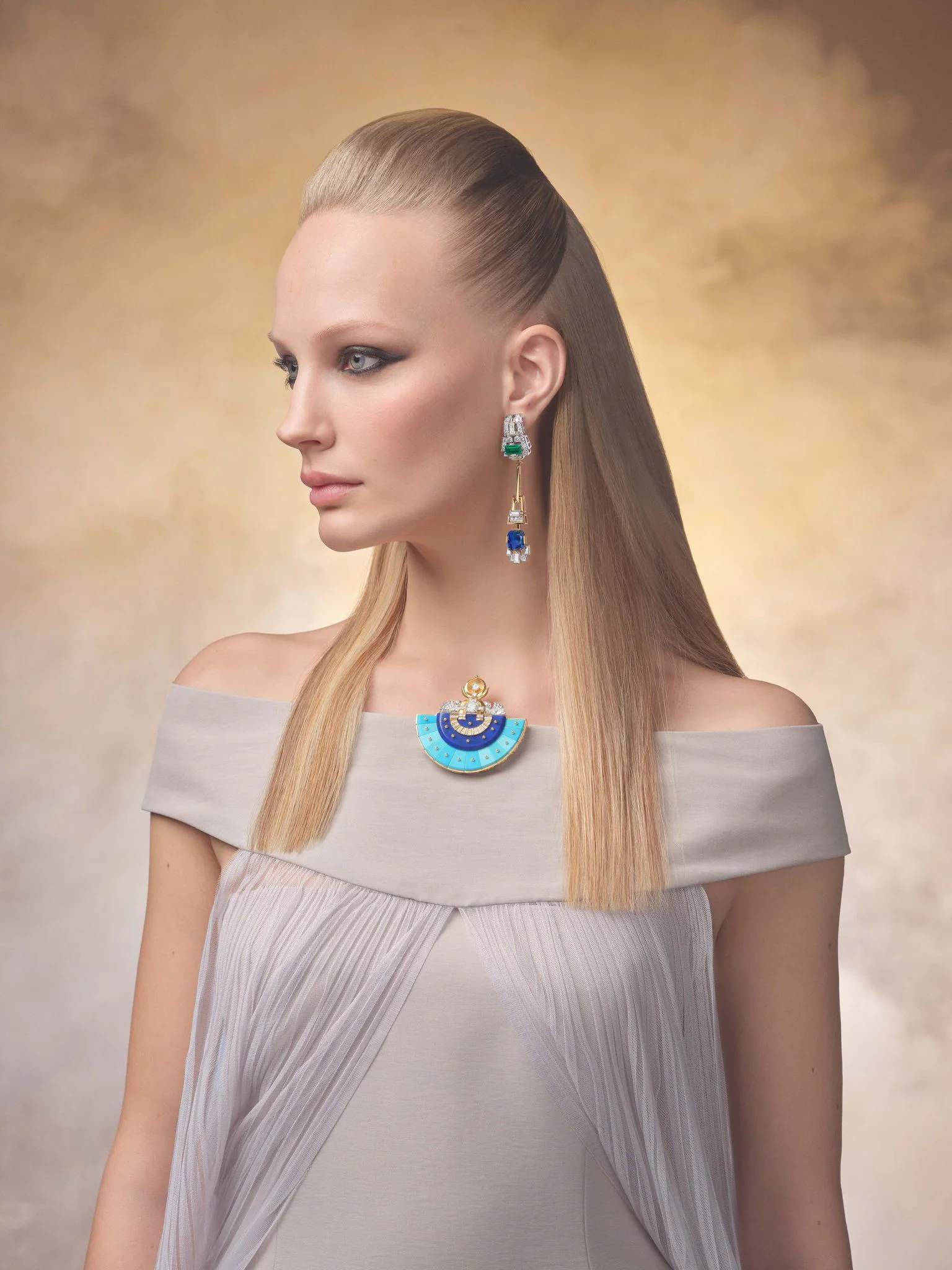
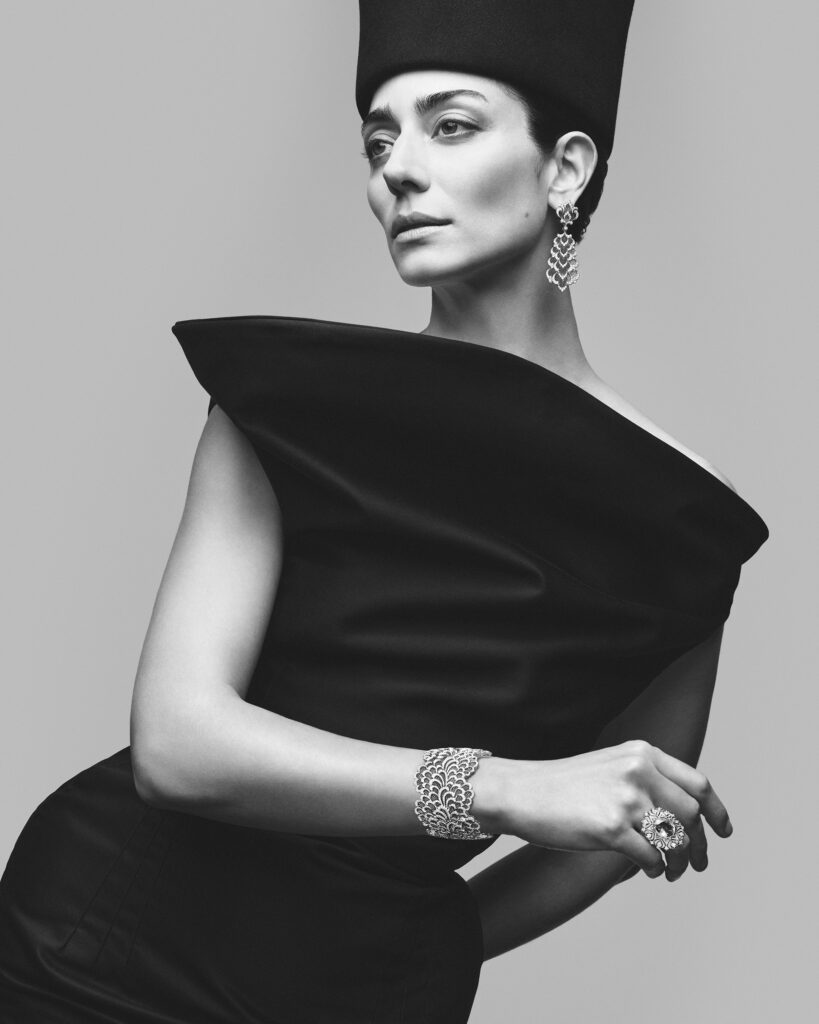
A century later, Van Cleef & Arpels delves into the wave of Egyptomania of the time following the discovery of Tutankhamun’s tomb in 1922 by Howard Carter, creating a first series of jewelry as early as 1923. Today, the maison reconnects with its Egyptian heritage, offering its interpretation with “Fascinations of Egypt “, some 180 pieces of High Jewelry recently unveiled in Paris.
The necklaces are particularly spectacular, reminiscent of the Legendary Beauty and Egyptian Shore pieces, echoing those worn by Pharaonic royalty. The cocktail rings Origin of Water, Floral Origin and Origin of the Sun transpose the signs designating these elements into gold and gems; three pairs of earrings draw their inspiration from the hieroglyphic symbols associated with Isis, the Djed pillar, emblem of stability, and the goddess Bastet. As for the trio of clips Fragment of Happiness, Magnificent Fragment and Fragment of Beauty, each creation carries a frieze of hieroglyphs. The yellow gold and diamonds stand out from a fragment of ornamental stone and are enhanced by a colored stone. The meaning is hidden in the object and reveals itself to those who know how to decipher it.
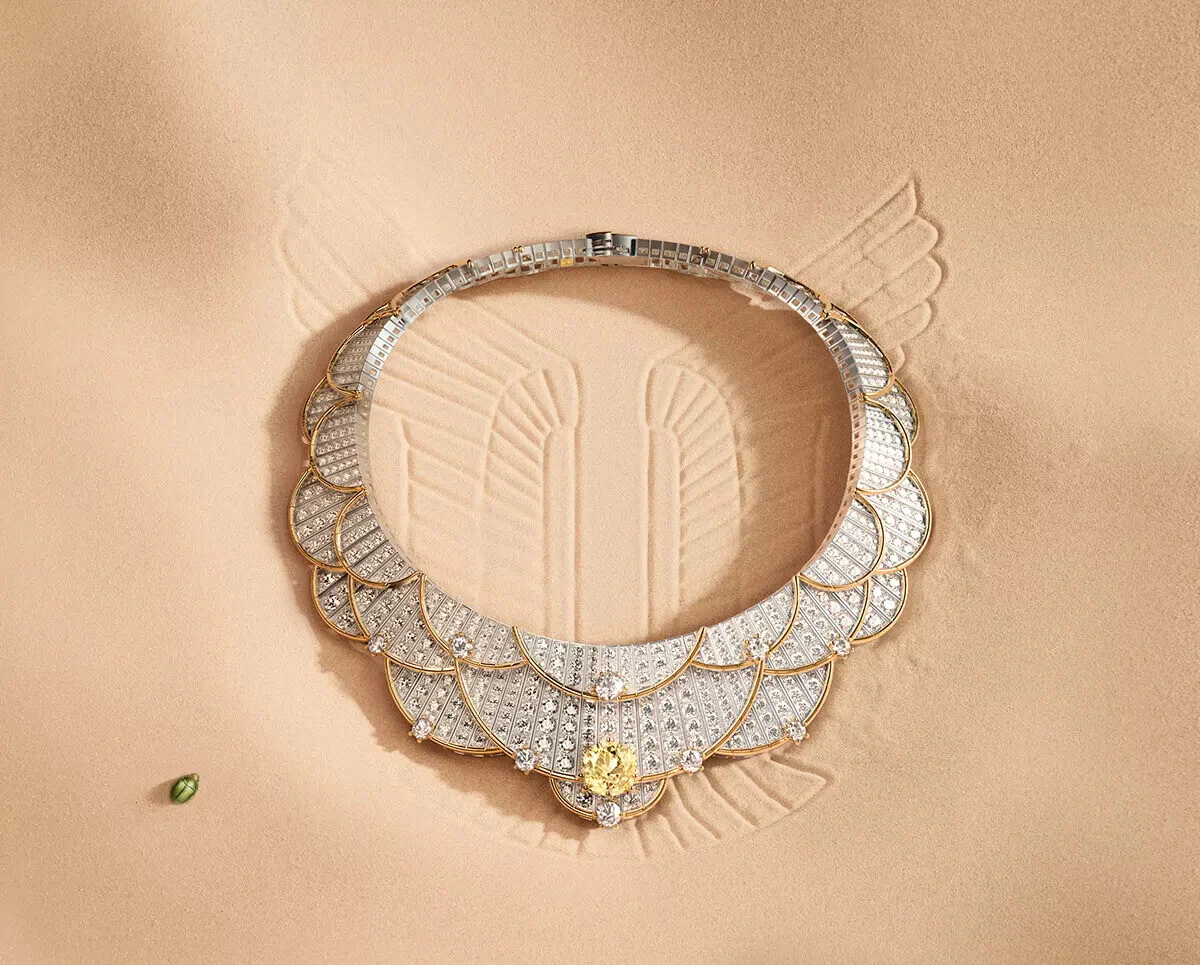
This aesthetic, laden with mysteries, reaches its technical pinnacle in the Serti Mystérieux, patented by the maison in 1933. The stones completely cover their setting, the gold disappears, and the color seems to float, unattached, on the Bénou Mystérieux clips, Griffon Mystérieux, and Bastet Mystérieuse, which revisit three major figures of the Egyptian pantheon. Elsewhere, it is the jewel itself that eludes and reassembles, notably, in the very graphic convertible necklace Mysterious Winged Goddess set with diamonds and rubies, and releasing a pear-shaped diamond of 14.05 carats that detaches to adorn a ring.
Memory, too, surfaces in watermark, and the maison‘s past resurfaces like a message retrieved from a chest. The adjustable gold and platinum necklace Princess of the Nile, with its 10 Colombian emerald drops and its seven fine pearls, thus echoes a Collerette necklace from 1929 acquired in 1937 by Princess Faiza of Egypt.
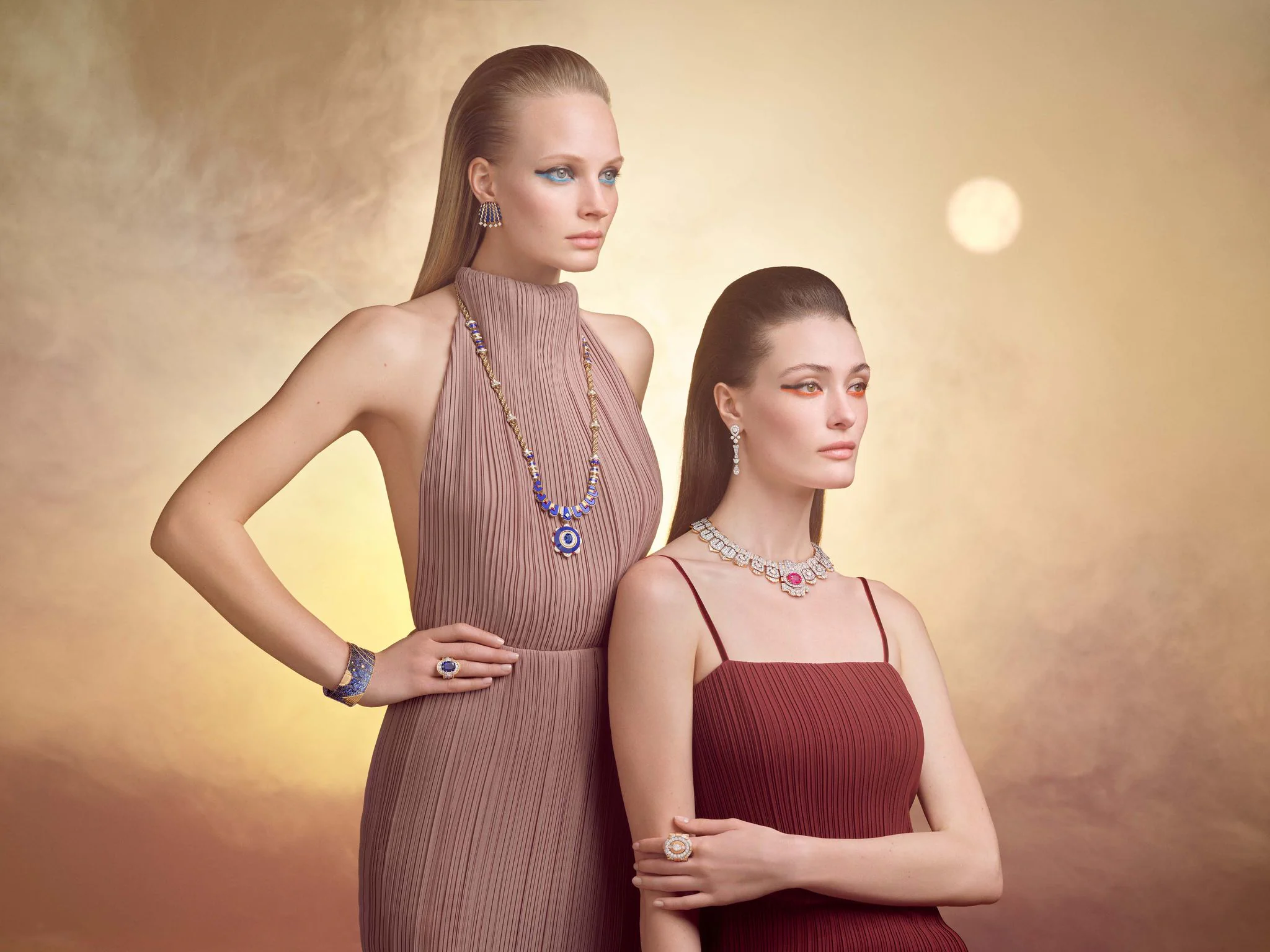
On the Secret Landscape bracelet—one of the most beautiful secrets of the collection—hieroglyphs nestled between columns of diamonds form a phrase that only the initiated will be able to read: “horizon of eternity”. Champollion had made Egypt readable; Van Cleef & Arpels has reintroduced mystery to it.